Hi, I am

Andreas.

Physicist turned software engineer.

I work with C++ and Python on automotive projects, with a passion for algorithms, complex systems, and open-source contributions in C++, Python, and Go.

About Me

I’m a software engineer with a background in theoretical physics, working primarily in automotive software development. Over roughly ten years, my work has included C++ development for sensor-related systems (camera, LiDAR, radar), Python-based sensor data analysis, and the development and maintenance of automotive-safe C++ core libraries.

In parallel, I contribute to open-source projects such as NetworKit, Gonum, DuckDB, and NetworkX. These contributions span algorithm implementation, numerical methods, performance-focused refactoring, dependency and code-quality cleanup, and the addition of tests and benchmarks.

I’m especially interested in algorithms, data structures, and performance engineering — not just in theory, but in how systems behave in practice under profiling and reproducible benchmarks. More recently, I have also been deepening my work in Go, build systems, and containerized development workflows, with a growing interest in scalable and distributed software.

Experience

Robert Bosch GmbH - Product Owner

Product Ownership & Leadership

  • Led the consolidation of two parallel C++ base-library initiatives into a single cross–business-unit platform, securing executive approval and establishing clear ownership, strategy, and roadmap.
  • Built and aligned a team including three senior engineers around shared product goals, delivery priorities, and quality expectations.
  • Drove the first series release of an ASIL-B automotive C++ foundation library within six months, establishing the product as production-ready under demanding quality constraints.
  • Shaped and operationalized the release process in an evolving process landscape, aligning engineering execution with process and quality management and helping enable one of the first successful series-ready releases in that environment.
  • Acted as the primary interface between internal customers and engineering, balancing requirements, prioritization, and technical constraints across multiple teams.

Hands-on Engineering

  • Continued contributing hands-on as a C++ developer alongside product ownership responsibilities, helping unblock delivery across automotive-safe containers, type-safe SI units, type-safe linear algebra, and CI-related topics.
  • Transferred and introduced established performance benchmarking practices from prior core-library work, seeding initial benchmarks and setting expectations for performance-aware development across feature streams.
  • Supported release-critical technical work and quality closure efforts, helping drive the product to zero open SCA findings and full line and decision coverage at first series release.
Robert Bosch GmbH - Senior SW Developer

Development of an automotive header-only C++ library

C++

  • Improved runtime performance of selected C++ APIs by up to 17× by implementing a benchmarking framework that measured instruction counts and CPU cycles across four compilers.
  • Achieved 2× faster runtime for trivial types and 5–20% lower memory use in embedded automotive systems by implementing a template specialization for a std::optional-like type.
  • Boosted runtime performance in release builds by ~10% across 10+ customer compilers by adding move semantics to fixed-capacity containers (vectors, lists, maps), benchmarked with Google Benchmark.

Python

  • Reduced maintenance load by ~5% by automating analysis of 20+ customer repositories, identifying 50 unused public APIs and driving deprecations.

Leadership

  • Fostered a customer-centric team culture by prioritizing feature requests in the backlog, organizing them into epics/stories, and implementing the first requests, leading to active developer engagement with customer needs.
  • Converted a frustrated customer into a satisfied one by establishing and carrying out the Developer Relations Engineer role, directly addressing customer developers’ issues.
Robert Bosch GmbH - SW Developer

Task force support: Refactored GPS-Based Route Prediction Component

C++

  • Reduced code complexity by 25% and eliminated 1,500+ lines in real-time radar-based situation interpretation algorithms through template-based redesign and restructuring of “iceberg classes.”

Python

  • Reduced development time by 33% during a tight project deadline by implementing a Python-based automated toolchain that tested thousands of output signals for functional correctness during code refactoring.
  • Accelerated rare-event detection by ~40× by implementing Python scripts to retrieve, convert, and analyze ~1,000 recorded sequences from radar-based driver assistance systems.
Robert Bosch GmbH - Research Engineer
  • Developed and maintained C++ modules for camera image and metadata processing to support labeling and training workflows.

  • Administered an Azure-hosted SQL database for image metadata and label storage, ensuring reliable data access and schema evolution.

  • Integrated Azure DevOps and Azure ML pipelines to automate label data deliveries and schema updates.

  • Expanded Azure ML pipelines and SQL-based workflows to improve data handling, scalability, and pipeline functionality.

  • Developed a deep-learning–based prototype for LiDAR blockage detection in Python, achieving ~90% detection probability in staged pollution scenarios.

  • Performed in-depth analysis of LiDAR sensor performance under diverse contamination scenarios, identifying key factors affecting accuracy and reliability.

  • Engineered and extended a Python preprocessing framework for point cloud data, supporting multiple LiDAR types (multi-return, intensity, and other features) to streamline training data generation and augmentation.

  • Created accurate LiDAR sensor models to enable comprehensive sensor-set evaluations.

Leadership

  • Coordinated the development of the first multi-sensor 3D box labeling toolchain, streamlining annotation workflows across multiple teams.
ITK Engineering & ASAP Engineering - SW Developer

Projects

  • Analyzed large-scale mobility data using Python, extracting insights for customer research projects.
  • Implemented a new API in the customer’s C# software stack, enabling smoother system integration.
  • Debugged the Fresnel integral calculation in customer C++ software to ensure accurate road curvature computation.
  • Evaluated real-time performance of charting and plotting libraries (C++/C#) on customer hardware, guiding technology choices.
  • Developed C# desktop software to analyze electronic control units (ECUs), improving diagnostic capabilities.

Leadership

  • Led and coordinated a team of five developers to refactor a customer’s Java software system, improving maintainability and project delivery.
University at Buffalo (USA), University of Würzburg (Germany) - Postdoctoral Researcher

Postdoctoral Researcher in Theoretical High Energy Particle Physics

  • Conducted large-scale numerical computations and Monte Carlo simulations in quantum field theory.
  • Published in peer-reviewed journals and presented at international conferences.
  • Supervised doctoral students and contributed to collaborative research projects.
  • List of publications

Education

Sep 2004 - Sep 2008
Doctor rerum naturalium (PhD equivalent)
Karlsruhe Institute of Technology (KIT), Germany
GPA: magna cum laude
High-energy particle physics. Conducted in-depth research and numerical computations, resulting in publications in peer-reviewed journals.
Oct 1998 - Aug 2004
Diplom in Physics (equivalent to M.Sc.)
Karlsruhe Institute of Technology (KIT), Germany
GPA: grade 1.1 (sehr gut, ≈ GPA 3.9–4.0 / A)
Comprehensive study in various fields of physics, honing analytical and quantitative skills.

Open Source Contributions

NetworKit — Graph Algorithms & Performance (C++ / Python)

Selected feature contributions

  • Left–Right Planarity Test
    Near-linear-time planarity check based on the Left–Right algorithm; full C++ implementation with extensive tests.
    • Initial implementation: PR #1276
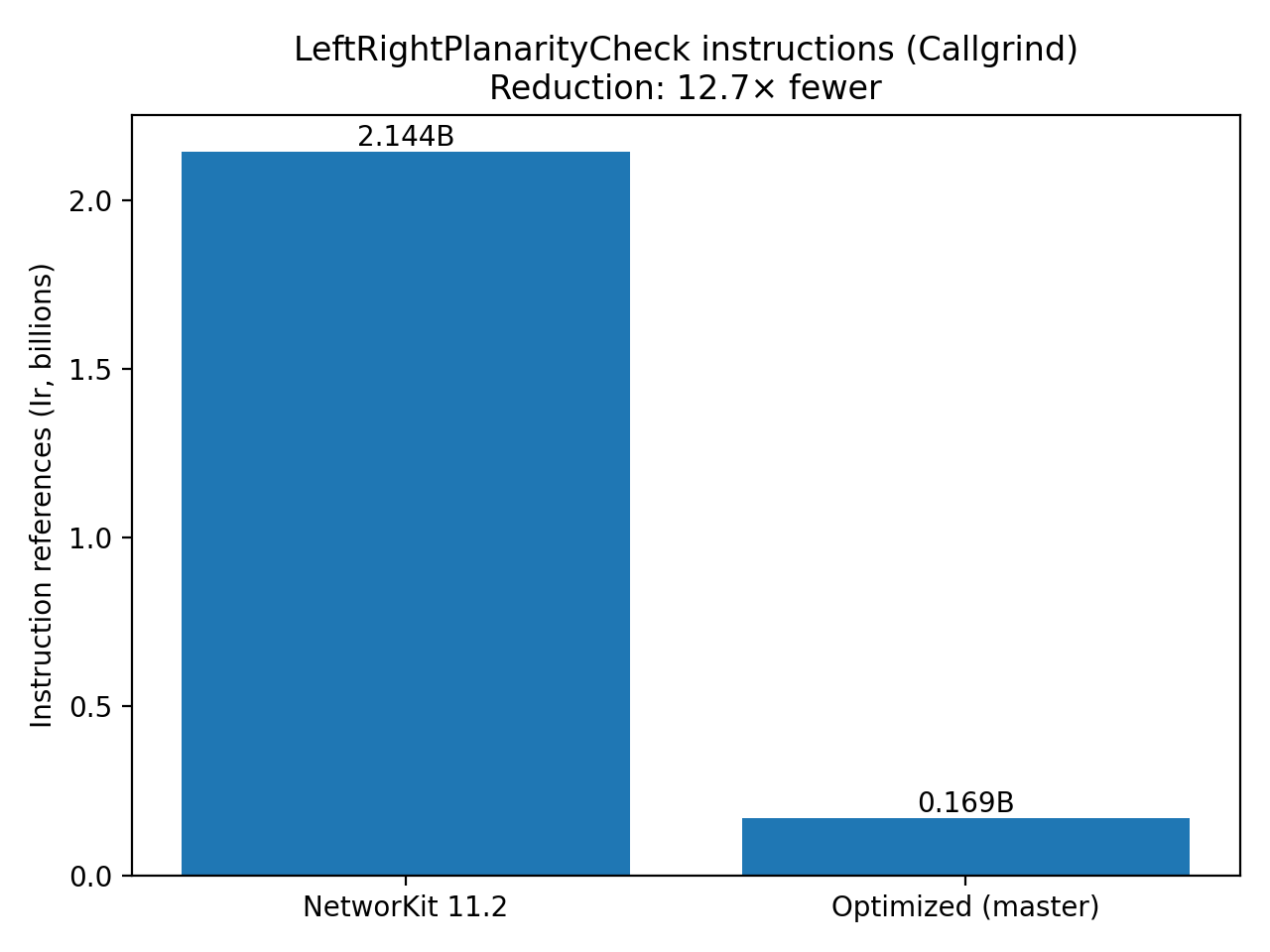
    • Performance rewrite: ≈100× faster isolated runtime (Google Benchmark) and up to ≈20× faster planarity test-suite: PR #1377
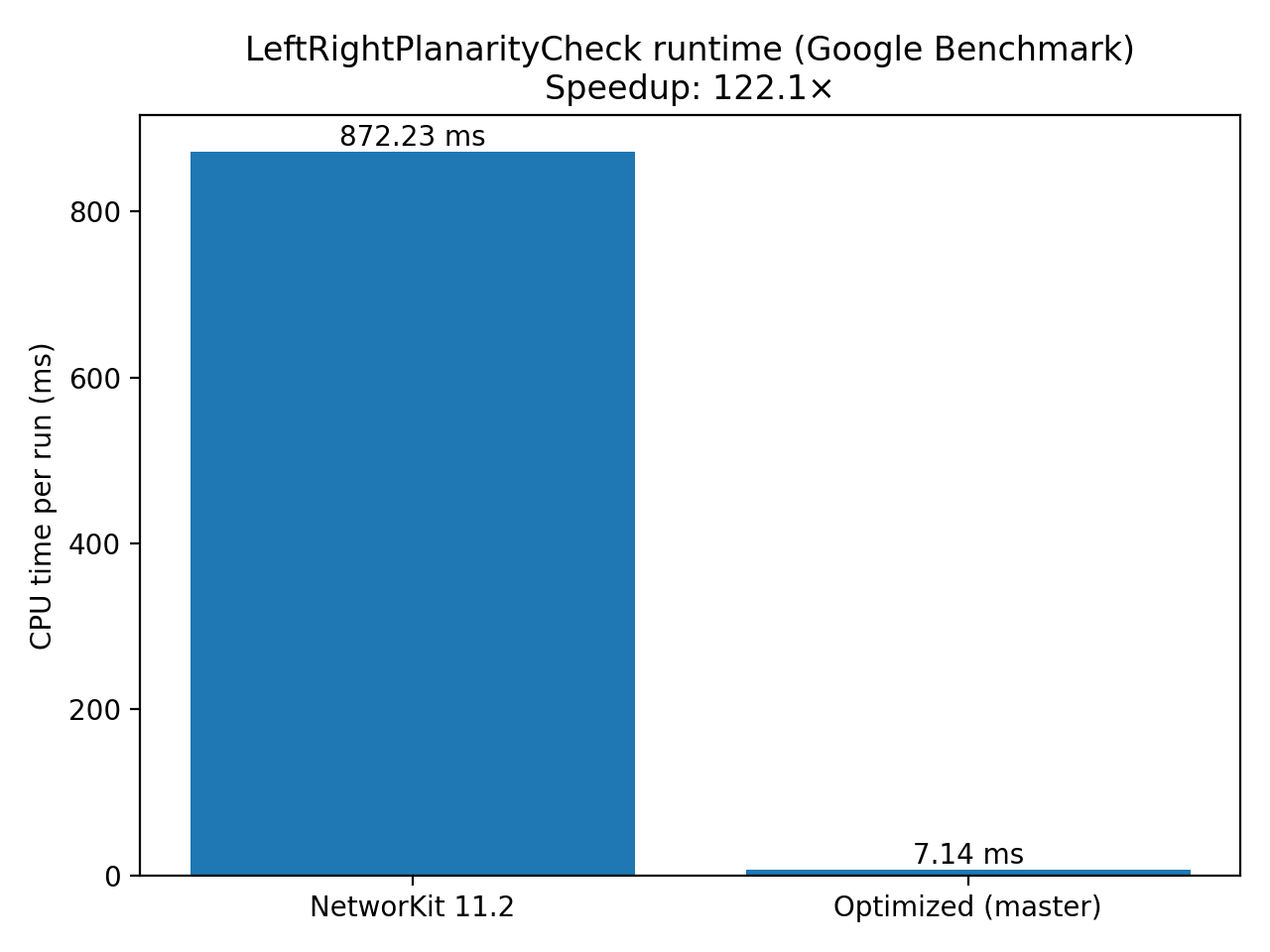
    LeftRightPlanarityCheck runtime (Google Benchmark)
    LeftRightPlanarityCheck instructions (Callgrind)
  • Floyd–Warshall with OpenMP parallelization
    All-pairs shortest paths with shared-memory parallelism; performance study on bit-level containers.
    ~40% fewer dynamic instructions using std::vector<uint8_t> instead of std::vector<bool>.
    PR #1312

  • Successive Shortest Path (min-cost flow)
    Computes minimum-cost flows under capacities and supplies/demands.
    PR #1349

  • Maintenance & ecosystem work
    Ongoing features, bug fixes, code-quality improvements, Python bindings, and developer tooling.
    Merged PRs

Gonum — Algorithms & Numerical Computing (Go)

Selected algorithmic & numerical contributions

  • Dinic’s algorithm (max-flow)
    Level-graph & blocking-flow implementation.
    PR #2051

  • Dilogarithm (Li₂) — implementation & optimization
    Numerically stable special function used in physics and number theory.
    • Initial implementation: PR #2059
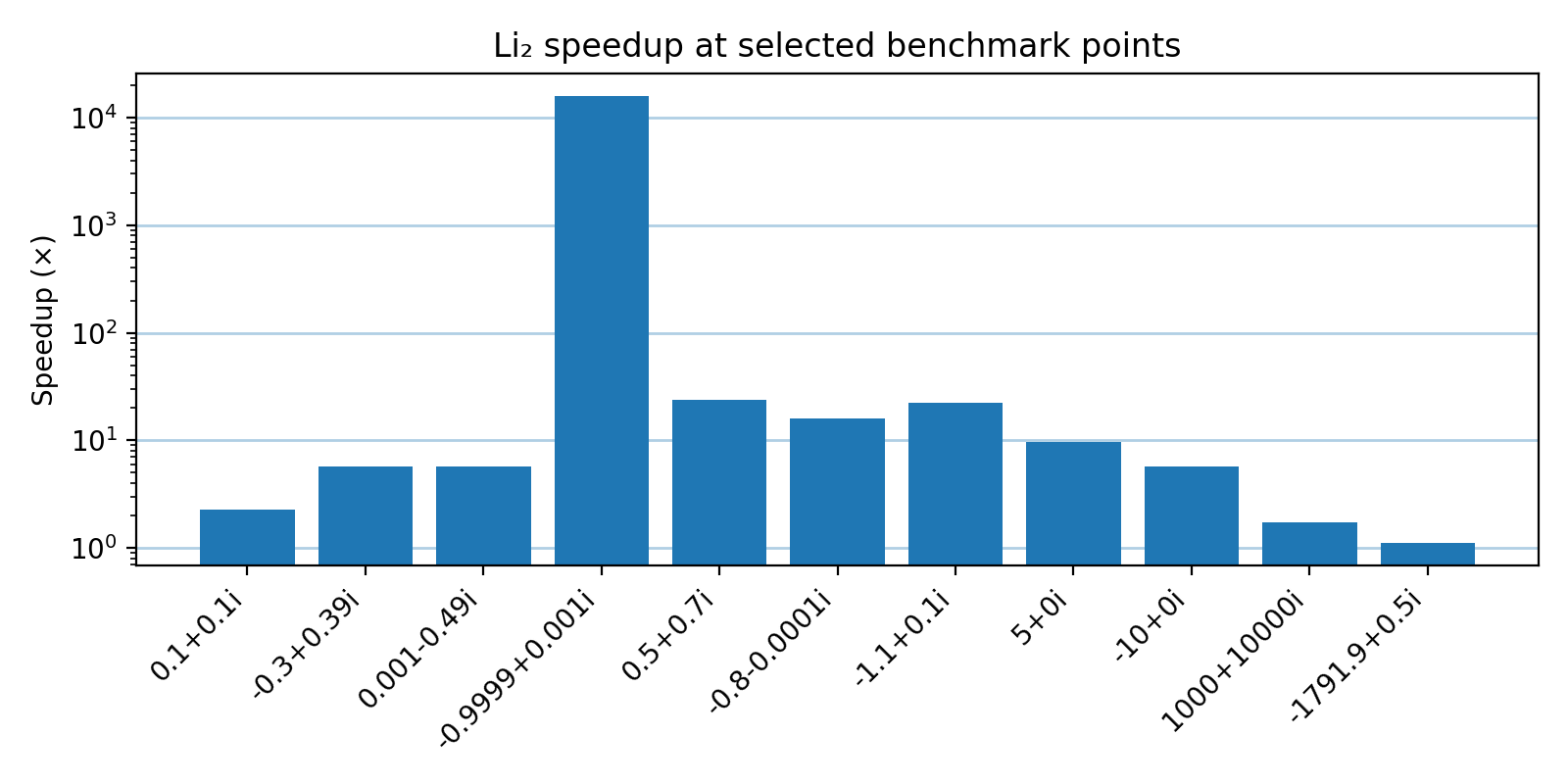
    • Performance & benchmarks: PR #2062 Dilogarithm speedup on a log10 scale.
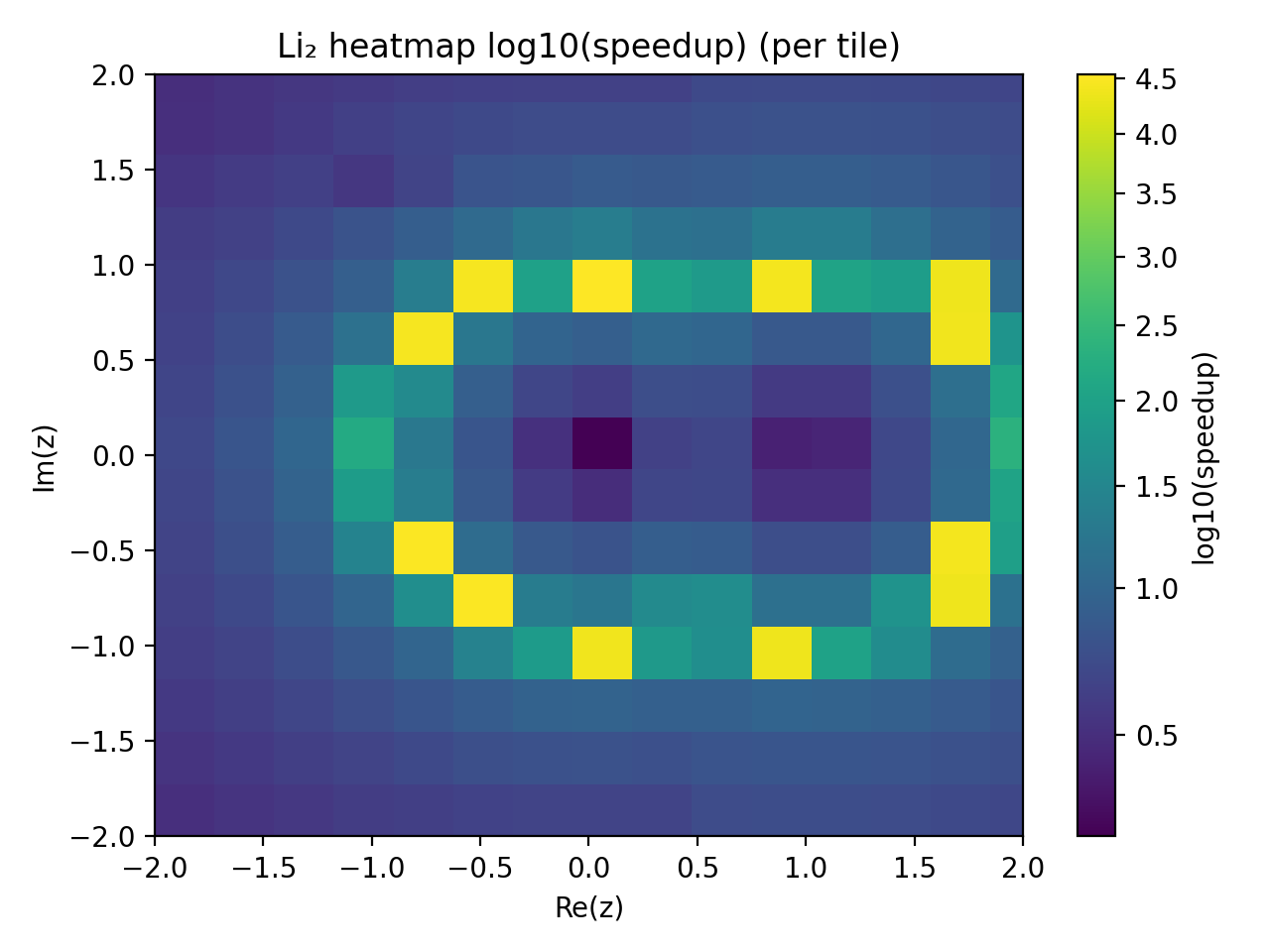
    Dilogarithm speed up for 11 selected points.
  • Transitive Reduction (Directed Acyclic Graphs)
    Implemented optimized DAG transitive reduction using pruned DFS, dense indexing with generation counters, and reusable scratch buffers to minimize allocations; benchmarked for runtime and memory improvements.
    PR #2070

Additional Open-Source Work
  • DuckDB (C++ & Python)
    Resolved a segmentation fault in the DuckDB core overwrite path, backported to the v1.4-andium release branch; added a targeted regression test: PR #20468
    Fixed a memory leak in the DuckDB Python bindings by correcting object lifetime handling; added regression coverage: PR #245
    Removed hundreds of unused headers across the DuckDB core and storage layers, improving compile-time dependency hygiene and long-term maintainability: PR #18422, PR #20407
    Fixed incorrect SQL identifier quoting in the Python API’s select_dtypes projection path, preventing query binder errors for quoted columns: PR #242

  • NetworkX (Python)
    Bug fixes and correctness improvements in graph algorithms.
    Merged PRs

  • TiDB (Go)
    Exploratory contribution to a distributed SQL database; initial PR under review.
    In progress

Get in Touch

My inbox is always open.